














MIDVALE, UT — Last Friday, Rob Zombie returned with his eighth solo album, entitled “The Great Satan.” Following the album “The Lunar Injection Kool Aid Eclipse Conspiracy” and aiming to recapture some of the magic of his first two albums— “Hellbilly Deluxe” and “The Sinister Urge,” this latest album proves to be a (mostly) successful return to his most famous releases.
One thing that listeners should know before listening to the album, however, is that every track on the album is incredibly short. Where on the first two Rob Zombie solo albums and the latter two White Zombie albums generally had track lengths of roughly 3-5 minutes, “The Great Satan” contains no tracks that are 4 minutes long and many that are under 3 minutes. This is not necessarily a problem, as there are 15 songs in total, but it does mean that many songs taken on their own might not feel terribly satisfying.
Another thing to note about the album is that much like the other Rob Zombie albums, the lyrics generally don’t make much sense. This isn’t really a flaw with the album— after all, every Rob Zombie album has pretty nonsensical lyrics— but it may subdue some of the appeal that people typically get out of music.
Getting into the actual content of the album, much of it is pretty standard fare for a Rob Zombie album. Many songs contain samples from films— presumably many of which are horror— and the subject matter of the songs tends to match this quite well. The album also moves at a brisk pace, with much of it being pretty fast.
Fascinatingly, this album seems to improve around the second half. While the first half has two of the singles (“Rock and Roller” and “Heathen Days”,) the back half has perhaps the better selection of songs. Notably, the song “Sir Lord Acid Wolfman” provides a nice change of pace from the faster-paced songs of the first half. This is in contrast to some of Rob Zombie’s earlier work— for instance, the album “Hellbilly Deluxe” contains its most famous songs (“Dragula,” “Living Dead Girl,” and “Demonoid Phenomenon,” to name a few) while the back half seems to be comprised of many shorter songs and intermissions. This actually helps the album, as having many of the best tracks near the back-end seems to leave a better impression after listening.
Perhaps the biggest downside to the album, however, is that it can often feel like the songs are not terribly distinct from each other. Previous albums like Hellbilly Deluxe would likely be like this as well, but the key difference may be that every few songs there would be a shorter track— almost like an intermission. Here, there are only two of these “intermissions,” which means that it can often make the album feel more forgettable. The stretch of songs from “Tarantula” to “Heathen Days” in particular seemed to drag on for me, as after the opening song it felt as though even the singles were very average.
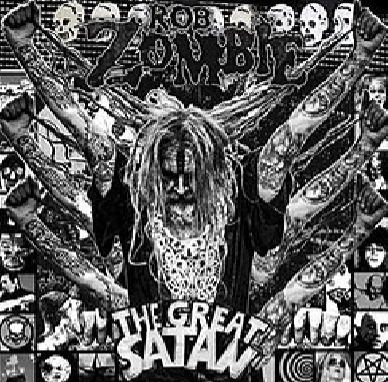
This feeling of the album being “average” also persists when looking at the album art and title. Many of the previous Rob Zombie albums had long, almost nonsensical titles, but here, the album title “The Great Satan” feels like it could belong to any metal band— it doesn’t feel unique to Rob Zombie like the other titles do. This is unfortunately compounded by the fact that an earlier album by the band Ministry (who are also an Industrial Metal band) entitled “Rio Grande Blood” had a song on it that was also called “The Great Satan,” with the album art for both releases featuring a similar pose. This is not to say that Rob Zombie copied Ministry intentionally, but it can be seen as an instance of “The Great Satan” feeling very “by the numbers” compared to previous works. Even the font used for the artist name on the album art is pulled from the first two Rob Zombie solo albums, which almost feels like icing on the cake when combined with the other similarities to other albums.
(the album art for “The Great Satan” and “Rio Grande Blood” for comparison)
At the end of the day, this isn’t a terrible album. In fact, compared to many metal albums released over the past few years, it is actually quite good. However, when compared to previous albums by Rob Zombie, it is really quite forgettable— on a first listen, only two of the songs really stuck out, one of which was a single. Overall, if you are a fan of Rob Zombie’s career, this will appeal to you— it is a good addition to his discography— but if you are looking for an introduction to the band, it is probably best to start out with his earlier releases.