











MIDVALE, UT — Last week, industrial rock and metal band Health released the “second part” to their popular album Rat Wars. Coming up on 20 years of being active, the band has released 6 albums, not including 2 collaborative albums and 4 remix albums.
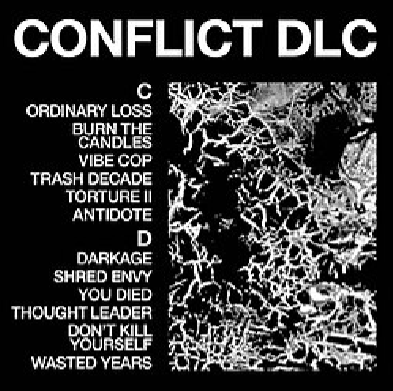
Perhaps the most interesting part of the release of the album is that it is not necessarily being promoted as their sixth album, but rather a continuation of their previous album. This is most evident in the track listing displayed on the album art: where Rat Wars (alongside their previous albums) used “A” and “B” to denote the separate sides of the album, Conflict DLC instead uses “C” and “D,” implying that it is not a “new” release, but instead a “part two” of Rat Wars.
Because of this, the album seems to beg for comparison to Rat Wars, both to its benefit anddetriment. While the album is indeed marketed as a continuation of the earlier album, it does have differences in sound, which undoubtedly will lead to people preferring one or the other. This is perhaps most evident in the slower songs on the album. While both albums have slower songs that are more melancholy than typical for the genre, those included in Conflict DLC are less somber than those from Rat Wars. While Conflict DLC does have slower songs- namely “Antidote” and “You Died-” they ultimately do not have the same impact that songs like “Ashamed (of being born)” and “Don’t Try” had on the previous album.
While this is not necessarily a flaw, it does show when comparing the two albums. In Rat Wars, the album ended with “Don’t Try,” which lent the album an almost cinematic feel, harkening back to songs such as “Hurt” on Nine Inch Nails’ acclaimed album The Downward Spiral or “Worm” on Ministry’s album Houses of the Molé. On Conflict DLC, the album ends with the song “Wasted Years-” while it is definitely one of the best songs on the album, it is ultimately faster than its predecessor on the previous album, making the ending feel less impactful.The reverse also applies here. While Rat Wars had songs like “DSM-V” and “Crack Metal,”
which move at an absolutely blistering pace, similar songs on Conflict DLC do not seem to
move as fast. This admittedly could be simply a case of myself not having listened to
Conflict DLC as much as the earlier releases, but the album never seems to move quite as
fast.
One strength that this album does have over Rat Wars, however, is the number of songs. One
of the biggest issues with Rat Wars was that while the album does indeed list 12 songs in the
track listing, it really only has 10- two of the tracks are continuations of two of the singles.
Conflict DLC does have one track that segues into a single (“Torture II”), but overall it does
not seem to have songs that should have been merged into one track. As a result of this,
while both albums are entirely comprised of great songs, Conflict DLC actually has more
actual “songs,” despite the shorter run-time and equal number of tracks.
One would be remiss not to mention how both albums run together. One of the most
important parts of an album is for the order of the tracks to make sense, as having poor
sequencing on the album can cause the listening experience to be incredibly unpleasant- for
instance, the album “Relapse” by Ministry. This is actually one of the biggest strengths of
both albums- it is incredibly easy to listen to one track on either album and just end up going
through the rest of the album. The sequencing is overall pretty good- there is only one
instance across either album of a jarring transition into the next song, and it is relatively
minor. Even the last track on Rat Wars, “Don’t Try,” seems to flow well into the first track
of Conflict DLC, “Ordinary Loss.”
This, unfortunately, does not necessarily mean that you should listen to both albums back to
back. Though both albums are great, they definitely have a different “feel” from each other.
Furthermore, as mentioned previously, Rat Wars has a more impactful closing song than
Conflict DLC does, which means that listening to them back to back can almost “cheapen”
the ending of Rat Wars.
At the end of the day, Conflict DLC is an incredible album that should be heard by any fans
of the previous album. If you want to be introduced to the band, it would probably be
preferable to listen to Rat Wars first, but Conflict DLC would be the best follow up (it is
technically a sequel, after all). For those looking for a fun album to listen to, Conflict DLC
will not disappoint.